Poe, Master of Horror
Traduzido por: Sofia Perestrelo
Edgar Allan Poe is considered by many to be the father of detective novels, a master of the gothic and of psychological terror, and a pioneer for science fiction. In his works we may find themes of death, obsession and madness, often led by unreliable narrators, to boot. The French author Baudelaire, renowned for his poetic compilation Flowers of Evil, was a key figure in the dissemination of Poe’s works in Europe. Later renowned authors, such as H.P. Lovecraft (At The Mountains of Madness), Arthur Conan Doyle (Sherlock Holmes) and Jules Verne (Around the World in Eighty Days) admitted to having been inspired by Poe’s works.
Poe was born in Boston, in 1809, to Elizabeth and David Poe. However, he became an orphan at the age of two, and was taken in and raised by a merchant, John Allan, and his wife. Throughout his life, Poe struggled with alcoholism and possibly drug use, but this did not stop him achieving great renown as a writer. He married once, to his cousin Virginia Clemm, who was then thirteen years old, while Poe was twenty-five. All sources indicate that Poe was deeply in love with Virginia, and fell into a great despair when she passed away only eleven years later – in the poem Annabel Lee, Poe expresses this grief fully. Yet, after careful analysis of his life, it is also possible that the great “love of his life” was his childhood sweetheart, Sarah Elmira Royster. The two were engaged before Poe’s marriage to Virginia, and after the latter’s death, they reunited.
As interesting as his life was, so too was his death: there are around twelve possibilities theorized to explain Poe’s death. Among them are an overdose, a brain tumor, and perhaps the most intriguing one - cooping. This was a form of electoral fraud, practiced by some gangs, in which the victim was kidnapped and made to vote several times on the same political candidate, using different fake identities. These voters were often coerced with the use of alcohol. Poe’s semi-conscious state and ragged appearance when he was found in distress, hours before his death, could be considered proof for this theory.
Many common themes of Poe’s work can be seen as a reflection of his turbulent life and troubled psyche, mainly his focus on the human mind, guilt, paranoia, and obsession. His stories’ narrators are often unreliable, and death, lost love and madness are abundant in his plots. It has been said that the author intentionally inserted self-biographical snippets in his works, although this has not been confirmed, to date.
Some of his classic tales include The Black Cat (perhaps not the best for cat lovers) and The Pit and The Pendulum. From his poetry, The Raven (the most famous of all!), Annabel Lee and Lenore stand out particularly. For fans of Sherlock-style mysteries, Poe also wrote “The Murders in the Rue Morgue”, so you won’t be left behind.
Like most authors of literary classics, Poe was involved, even if unintentionally, in controversies over morality and madness. Likely a lack of the former and excess of the latter, to his critics, since Poe’s works defied established literary standards of his time, like so many great writers before him. Somehow, he stood out even more due to the macabre violence present in many of his works and the dark humor pervasive to his style.
Lovers of the art of illustration might be delighted to know that his works were later represented visually by 20th century artist Harry Clarke, who took inspiration from cinema, theater and literature of his own time. This Irish illustrator is considered unique among many who illustrated Poe’s creations, for his precise ability to capture the psychological terror and gothic essence that the author intended.
With all the facts laid out, it’s safe to conclude that Poe was a writer far ahead of his own time, who will forever be known for exploring the human mind and its fears as no author had done before. He seems to enjoy keeping us, the unsuspecting readers, in a limbo between reality and imagination. One thing is certain: the master of horror has not truly died – to this day he haunts us through his stories.
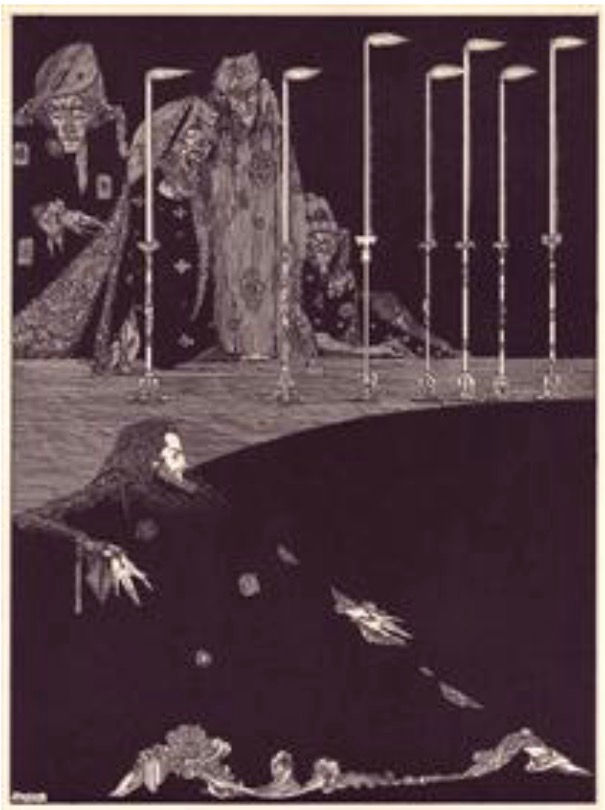
Illustration by Harry Clarke for Tales of Mystery and Imagination.
Comentários